
Wholesale Jewelry Manufacturing: Quality Control Points
Quality control in wholesale jewelry manufacturing is a sequence of five checkpoints rather than a single look at the end. The published positions put a check after casting, after setting, after polishing, after plating and again before packing, with the final pass covering 100% of pieces. A supplier that can name those five moments is describing a process you can audit; one that cannot is describing a promise.

Key takeaways
- Five inspection checkpoints run from after casting through to before packing.
- Inspection covers 100% of pieces rather than a sample, and it is its own step in the sequence.
- Six specification points give quality control a written standard to check against.
- MOQ is 100+ pcs in the stainless line, 50 in 925 sterling silver and 100 pcs in artisan eco-brass, by design, applied design by design.
Quality control is a sequence, not a final glance
A workshop that inspects once, at the end, can still ship a batch that photographs well and fails in a month. Placing checks between operations changes which defects are possible: a casting flaw never reaches the plater, a loose stone never reaches the polishing wheel, a thin plating coat never reaches a carton.
That is the difference between defect detection and defect prevention. The five checkpoints are cheap to add because they sit at the end of operations that were happening anyway; the saving is the rework that never takes place.
The published quality system behind the sequence is ISO 9001:2015, which describes a documented process repeated across every production stage. Documentation is what turns five checkpoints from a habit into something a buyer can verify.
The five checkpoints and what each one catches
After casting, the check is for porosity and short fills, which show up as pits or incomplete detail before any finishing hides them. After setting, it is stone security and alignment, because a stone that moves under a polishing wheel damages the piece and the tool.
After polishing, the check is for wheel marks, burrs and any loss of definition, particularly on brushed and textured surfaces where an over-polished edge is obvious to a customer. After plating, it is coating thickness consistency and colour match against the approved sample.
The last checkpoint before packing is the widest: count, finish, hallmark position and packaging. It is the one that catches a batch which is technically correct but incomplete, and it is the one a buyer should ask about first.
What full inspection changes
A sampled inspection tells you about a batch. Full inspection tells you about every piece, which matters more in jewelry than in most manufacturing because each unit is a visible object handled by a customer.
A plated ring with a thin patch on one quadrant is a return; at a 1-in-20 defect rate, a sampled check of ten pieces can miss it entirely. Inspecting 100% of pieces removes that arithmetic from the equation.
The published statement is straightforward: final quality control covers 100% of pieces, and it appears in the process as a named stage rather than as a note in a freight document.
The wholesale line also publishes its own five-step service flow, and quality inspection is a named step inside it rather than an assumption: concept and design, master sampling, quality inspection, sample confirmation, mass production. The benchmark behind that step is published as well — the approved master sample is the reference for later orders, so the target is that batch #10 matches batch #1 on the same material sourcing and surface standard.
A specification is what quality control checks against
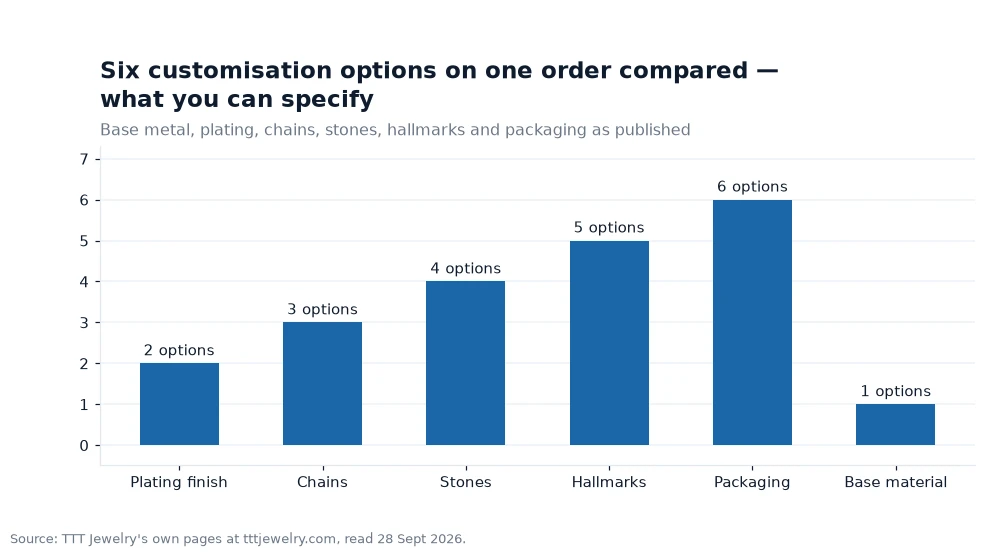
Inspection compares a piece to a standard, so the standard has to exist in writing before the run. Six points are published for a custom order: base metal, plating and finish, chains and findings, stones and accents, logo and hallmark, and packaging.
A buyer who leaves four of those unspecified has left four things uninspected, because nothing in the workshop can check a colour that was never agreed. The published specification list is the place to copy from, and a buyer can view details of all six points there before writing the order confirmation.
The practical trick is to make the order confirmation and the inspection sheet the same document. When the inspector reads the same line the buyer approved, a disagreement surfaces before packing rather than after delivery.
Why the minimum order quantity affects quality
The published minimums are 100+ pieces in stainless work, 50 in 925 sterling silver and 100 pieces in eco-brass, for each design, with each design counted separately. They apply per design in a custom jewelry wholesale order, which means each new silhouette carries its own floor and its own tooling.
The MOQ is not a quality threshold, but it is a consistency one. A run of 50 pieces shares a single plating batch, a single mould and a single stone lot, which is exactly what makes the pieces match each other.
Below the minimum, a workshop either reuses tooling from another design or spreads a batch across sessions. Both are the conditions under which batch variation appears.
Documents that make a defect traceable
Traceability is the part of quality control that buyers notice last and value most. The published record set is a BSCI social audit, REACH compliance and a quality system to ISO 9001:2015, with materials that carry no lead, cadmium and nickel.
Those three answer different questions: whether the process is documented, whether the people running it work to a social standard, and what the metal actually contains. Together with the inspection checkpoints they form a chain from the material lot to the packed carton.
Ask for the inspection record alongside the shipment. A supplier with five checkpoints in place has something to hand over; a supplier with one final look has nothing to show.
| Checkpoint | What it catches | Published position |
|---|---|---|
| After casting | Porosity and short fills | check 1 of 5 |
| After setting | Loose or misaligned stones | check 2 of 5 |
| After plating | Thin or uneven coating, colour drift | check 4 of 5 |
| Before packing | Count, finish, hallmark, packaging | check 5 of 5, 100% of pieces |
Worked example: inspection events inside a single batch
Take the five published checkpoints and apply them to a batch. A 100-piece order is inspected five times over, which is 100 × 5 = 500 inspection events per batch. At the minimum of 50 pieces in 925 sterling silver the same run produces 250 events; double the batch to 200 pieces and it becomes 1,000.
The multiplication is mine; the five checkpoints and the 100% coverage are published. The useful part is what it says about batch size: inspection effort scales with quantity, so a larger run carries proportionally more finishing time before packing, not less.
It also explains why a supplier with a documented checkpoint list can quote a delivery date with more confidence than one working from a single final look.
Frequently asked questions
How many quality control points are in a production run?
Five: after casting, after setting, after polishing, after plating, and before packing, with 100% of pieces inspected at the final checkpoint.
What is the quality system behind the process?
A quality management system to ISO 9001:2015, alongside a BSCI social audit and REACH compliance covering lead, cadmium and nickel.
What determines the minimum order quantity?
Minimums are 100+ in the stainless line, 50 units in sterling silver and 100 in eco-brass, design by design, and they hold design by design.
Auditing a process instead of admiring a sample
A single sample proves that one piece can be made well; five checkpoints prove that the hundredth piece will match it. The production step list is the shortest way to see where those checks sit relative to the finishing operations, since inspection is a named step rather than a remark.
For plated work the later checkpoints carry most of the risk, so the PVD finishing route is worth comparing against wet plating before deciding which finish a daily-wear piece should use.
Every number in this piece — the three service strands together with the five service steps plus the six customisation options — originates at the supplier's own site on tttjewelry.com, in a visit dated 28 Sept 2026. The sums behind the example are my own, and nothing else here[1].