
Regional Fragrance Preferences and the Documents a Pharmacy Buyer Holds
Regional fragrance preferences end up in a document set, because the same scent is sold under different rules in different markets. Before a pharmacy own-label range goes live, the brand should hold a safety assessment, a specification, an allergen declaration, a conformity statement for the fragrance, quality certificates from the manufacturer and batch-level analysis, with market-specific additions where the law requires them. Collecting these at brief stage rather than before launch is the difference between a scheduled launch and a delayed one.
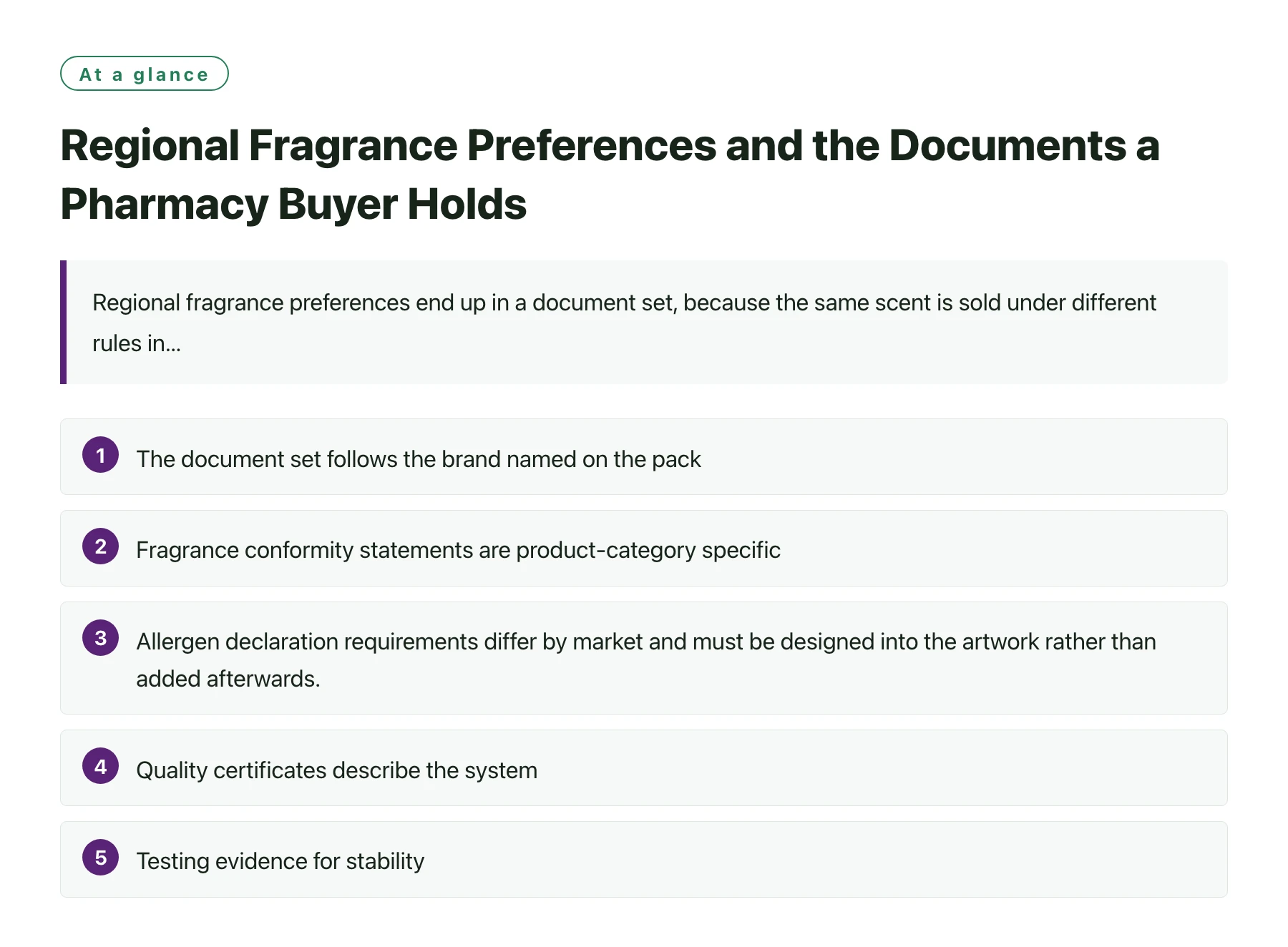
Key takeawaysThe document set follows the brand named on the pack, not the factory, so the brand has to hold and understand each item. · Fragrance conformity statements are product-category specific, which means the same scent needs separate documents for a fine fragrance and a body lotion. · Allergen declaration requirements differ by market and must be designed into the artwork rather than added afterwards. · Quality certificates describe the system; batch analysis and specification describe the actual goods, and a pharmacy retailer may ask for both. · Testing evidence for stability, compatibility and microbiology belongs in the file for leave-on body products. · A supplier that cannot list its documents in advance will cost the brand time during the retailer's approval process.
Preference work is creative until it reaches the pack, at which point it becomes a documentation exercise. A scent approved for a pharmacy range has to be described accurately, assessed for safety in the format it is sold in, and supported by evidence that the goods match the specification. Each market layers its own requirements on top, and the layers are the reason two identical bottles can need two different files.
Retailers ask for these documents because the exposure sits with them if something is wrong. A pharmacy group putting its name on a fragrance product is the brand for regulatory purposes in most markets, whatever the label says about who manufactured it, and that means the file has to be assembled and understood in house rather than left with the supplier.
The table below lists the documents a pharmacy own-label fragrance range normally needs, who prepares each one and what question it answers. It is followed by the market-specific additions that most often catch buyers out.
The core document set
| Document | Prepared by | What it answers |
|---|---|---|
| Safety assessment for the finished product | A qualified assessor engaged by the brand | Whether the product, as formulated and packaged, is safe for its intended use |
| Product specification | Manufacturer, approved by the brand | Exactly what is in the product, at what dosage, in what packaging |
| Allergen and ingredient declaration | Manufacturer, based on the formula | What the label must disclose to the shopper in each market |
| Fragrance conformity statement | Fragrance house or manufacturer | Whether the fragrance complies with current safe-use standards for the specific product category |
| Quality system certificates | Manufacturer | Whether the site operates under a recognised good manufacturing practice and quality framework |
| Batch certificate of analysis | Manufacturer's quality team | Whether the goods shipped match the approved specification |
| Stability and compatibility reports | Manufacturer or an external laboratory | Whether the product holds up over time and in contact with its packaging |
| Safety data sheet | Manufacturer or fragrance supplier | How the concentrate and the finished goods should be handled and transported |
A supplier that can produce this list on request, with a named owner for each item, is easier to work with than one that assembles documents after the order.
Where markets diverge
The core set is broadly similar across markets; the divergence sits in how ingredients are notified, how allergens are declared and what evidence supports a claim. In the European Union, cosmetics are placed on the market through a framework with a named responsible person and a product information file, and the European Commission publishes both the general framework and the specific topics that manufacturers and importers have to work through. [1]
Ingredient naming is a good example of why the same formula produces different paperwork. Regulators maintain ingredient inventories with agreed names and stated functions, and the European Commission's CosIng database is one of the references used to check how an ingredient should be described. [2] A brand that plans its label wording around those references avoids a late correction.
Industry associations provide guidance that helps suppliers and brands align on what good documentation looks like. Cosmetics Europe publishes material on how the sector approaches safety, labelling and claims, which is useful when a retailer's approval team asks questions that go beyond the minimum. [3] Markets outside Europe add their own layers: Health Canada, for example, publishes cosmetic safety requirements and ingredient provisions that a brand selling into Canada has to meet, and those requirements are checked against the same formula. [4]
Category matters more than market
Two products from the same range can need different documentation because they fall into different categories. A body lotion is a leave-on product applied to large areas of skin; a hand wash is rinsed off; a fine fragrance sits in a different exposure category again. Fragrance conformity statements and permitted use levels are tied to that category, so a range that spans formats needs a document per format even when the scent is identical.
Claims need evidence, not adjectives
Words such as gentle, dermatologically tested or suitable for sensitive skin are claims, and each one needs something behind it. Where the claim rests on testing, the report belongs in the file; where it rests on the formula, the reasoning belongs there. This is a place where an experienced manufacturer makes the brand's life easier, because it knows which claims are straightforward and which require new testing before the pack is printed.
How this changes the supplier conversation
The document set is one of the few parts of a fragrance project that can be assessed before any sample is approved. A buyer can ask for the list at the first meeting and see how the supplier responds: a clear list with named owners suggests a house used to working with retailers, while a vague answer suggests the documents will be assembled under pressure. A manufacturer that supports both brands and own-label work, such as a manufacturer that supports OEM and ODM, normally has the list ready because the two routes generate the same paperwork.
It is also worth separating the manufacturer's own certificates from the product documents. Site certificates describe the system in place; they do not certify a particular bottle. That distinction matters when a retailer asks for evidence about a shipment, because the answer sits in the batch records and the certificate of analysis, not in the ISO certificate on the wall. Where the range includes leave-on body care, safety testing in perfume and personal care manufacturing is part of what supports the file, and it should be planned into the development calendar rather than requested at the end. safety testing in perfume manufacturing
Finally, keep the documents in one place and in one version. The most common failure is not a missing document but two versions of the same one, with an allergen declaration from an earlier formula circulating alongside the current specification. Every time the formula changes, the affected documents should be reissued and the old versions withdrawn. Agreeing that discipline in writing with a supplier such as Xuelei fragrance house at the start of the project will save far more time at launch than any later attempt to tidy the file.
Ask for the document list before the sample round, not after. If the supplier can name every item and the person responsible for it, the paperwork will probably be fine; if the list is discovered during the retailer's approval, the launch date is doing the discovering.
Sources
- European Commission: Cosmetic Products — Specific Topics —— EU pages covering specific cosmetics topics such as product claims, nanomaterials and animal-testing rules.
- EU CosIng — Cosmetic Ingredient Database (European Commission) —— The European Commission's CosIng database of cosmetic ingredients, listing ingredient functions, restrictions and labelling requirements under EU cosmetics law.
- Cosmetics Europe —— The European trade association for the cosmetics and personal care industry, publishing guidance, positions and market information.
- Health Canada: Cosmetic Safety —— Health Canada's cosmetics pages, covering cosmetic notification, the ingredient hotlist and safety requirements for cosmetics sold in Canada.
Frequently asked questions
Whose responsibility is it to hold the compliance documents for an own-label fragrance?
The brand whose name is on the pack, which in a pharmacy own-label range is the retailer. The supplier prepares much of the material, but the brand holds the file and is answerable for it.
Can one safety assessment cover several products in a range?
Only where the products are genuinely comparable in formula, format and packaging. Different formats applied differently to the skin usually need their own assessment, and a range that mixes fine fragrance with body care should expect more than one.
Why does the same scent need separate fragrance conformity statements?
Because permitted use levels depend on the product category. A formula that complies in a fine fragrance is not automatically compliant at the same dose in a leave-on body product, so the statement is issued for the category in which it will be sold.
How early should allergen information be available?
Before artwork is finalised. Allergen declaration rules differ by market and the wording affects the pack, so the information has to arrive at design stage rather than at the printer.
What if a supplier cannot provide batch certificates of analysis?
Treat it as a material finding. Batch analysis is how the goods are shown to match the specification, and a retailer's quality team is likely to ask for it. A supplier that cannot provide it is a risk to the launch date as well as to the file.